


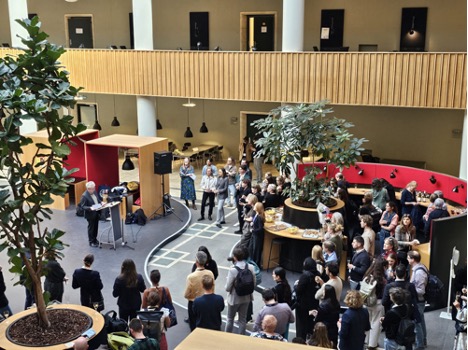
We are pleased to announce the launch of AcademicResilience.eu — a new platform developed within the OPEN COST Action as part of the work of Working Group 4. We have created the platform to support academic freedom and strengthen academic resilience across Europe. It brings together a range of practical resources for academics at risk and for those navigating pressures, attacks, or harassment in their academic environments.
The website brings together a range of resources designed to support academics at risk. Its main initiative is the OPEN NEXUS Support Program, which connects researchers with experienced mentors who can provide a sympathetic ear and some advice.
On this website, you will also find:
- the online version of the Pocket Guide for Academics Under Attack, with forewords from important figures in the higher education sector.
- materials from past Training Events for Academic Resilience,
- an interactive map of higher education trade unions across Europe, made to facilitate initial contact and collaboration.
If you are facing attacks or other forms of harassment in your research or more broadly in your academic environment, we encourage you to explore this website, access available resources, and request personalized support via our contact form if needed.
Links: academic.resilience.eu
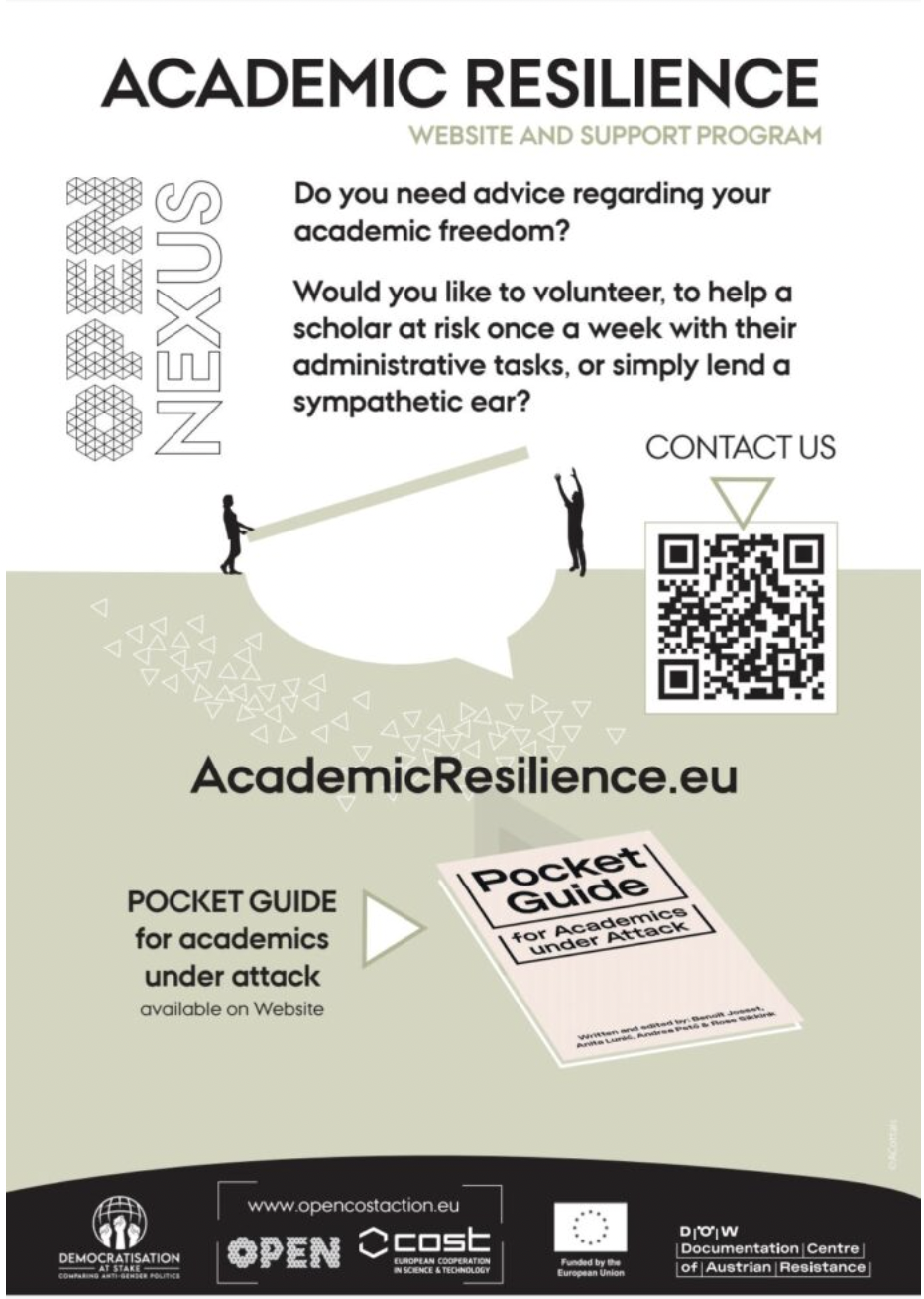
Do you need advice regarding your academic freedom?
Would you like to volunteer, to help a scholar at risk once a week with their administrative tasks, or simply lend a sympathetic ear?
This Pocket Guide has been created by two COST Action : “Rising nationalism, shifting geopolitics, and the future of European higher education/research openness” (OPEN) and “Democratisation at stake? Comparing anti-gender politics in CEE and NME countries” (Anti-Gender Politics).
This pocket guide addresses a critical paradox: while scholarly work on threats to academic freedom is rapidly expanding, individual academics often lack practical, accessible support when confronting these pressures firsthand. The guide offers a grounded framework for recognizing early warning signs, understand- ing their structural roots, and identifying proportion- ate responses. It draws on 15 years of analysis of institutional flashpoints in which academic freedom and autonomy were undermined, revealing recurring patterns in how small procedural shifts or informal pressures can accumulate into deeper institutional transformation.
Rather than assuming bad faith or prescribing rigid solutions, the guide equips readers to sharpen their perception, maintain awareness of available resources, and strengthen their capacity to act. It emphasizes that academic freedom anchored in international human rights frameworks requires not only institutional pro- tection but also individual attentiveness and prepar- edness. Knowing whom to contact and whether some- one will listen can be decisive when operating under strain.
Designed as a flexible service guide, it addresses diverse institutional roles and political contexts, including faculty, early-career researchers, administrative staff, academic leaders, and advocates. Readers may consult sections as needed.
Complementing the guide, the authors offer a two-hour online introduction and an eight-module Academic Resilience Training program that focus on legal, digital, mental-health, practical, and research-related challenges in hostile environments. Together, these resources help build sustainable resilience across the academic community.
The Pocket Guide iis written and edited by Benoît Josset, Anita Lunic, Andrea Petó & Rose Sikkink
Materials from the previous Training Schools:
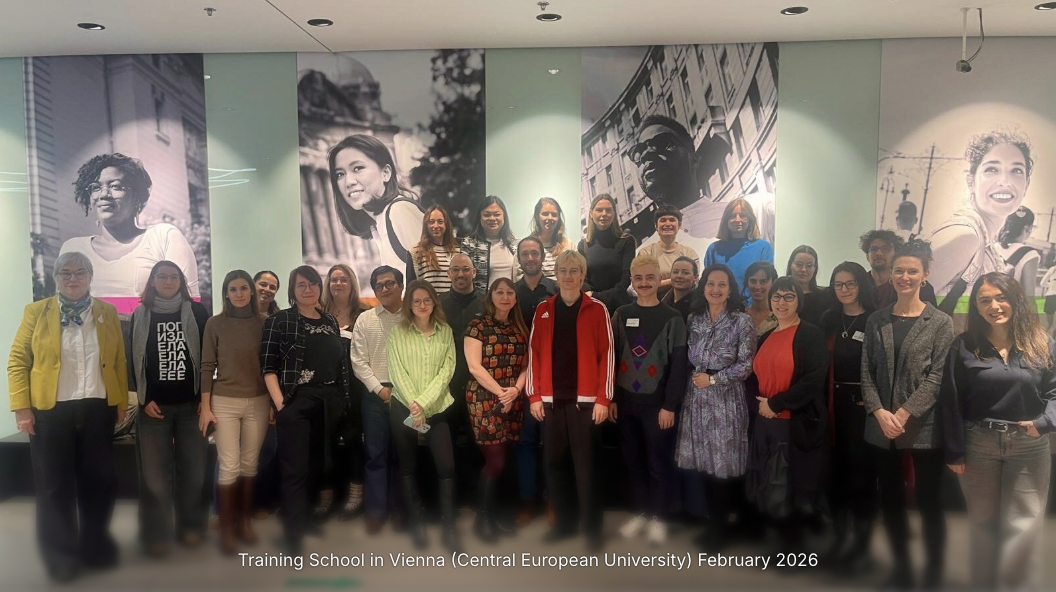
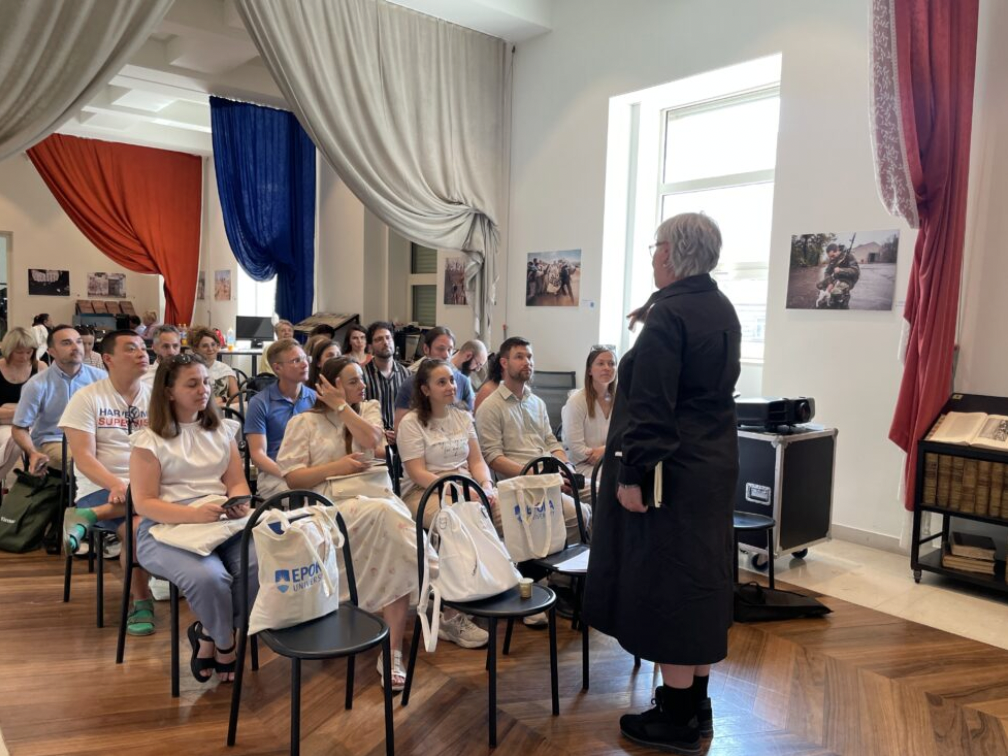
These Training events aim to bring together PhD students, postdoctoral researchers and early-career researchers to discuss ways of building resilience within the academic community and defending academic freedom. Although these programmes are primarily aimed at early-career researchers and academics, they are also open to university staff and lecturers, university administrators and leaders, as well as advocates for academic freedom.
With this interactive map, you can find and get in touch with the main trade unions relevant to higher education and research in various European countries.
In the process of developing the conceptual framework for the COST Action on “Rising Nationalism, Shifting Geopolitics and the Future of European Higher Education/Research Openness,” we recognized the importance of considering the dynamic and multifaceted nature of the issues at hand. The framework is grounded in the understanding that the phenomena of nationalism, geopolitical shifts, and research openness cannot be fully understood without careful attention to the specific contexts in which they unfold. At the same time, by examining a few examples of case studies of nation-states with different political, social, and academic environments, we aim to highlight the ways in which these larger concepts interact with and are influenced by context-specific ‘variables'.
Central to our framework is the concept of context sensitivity, which plays a crucial role in understanding the interplay between nationalism, higher education, and research openness. Context sensitivity refers to the need to be aware of and responsive to the unique characteristics and variables of each nation-state setting when studying these phenomena.
In the diagram, beyond the context-sensitivity mentioned in the earlier paragraph, we focused on the OPEN Cost Action key components named as “International Engagement”, “Higher Education”, “Openness in Research” and “Nationalism” to be utilized in comparative and context sensitive research. Each of these components in the diagram and shared concepts in the intersections could be applied to country contexts depending on the aim of the research on higher education. Within the scope of “Higher Education System”, researchers can elaborate the historical development of higher education, the size, structure and management of the higher education system as well as the government's policies on higher education and financial mechanisms including research and development.
